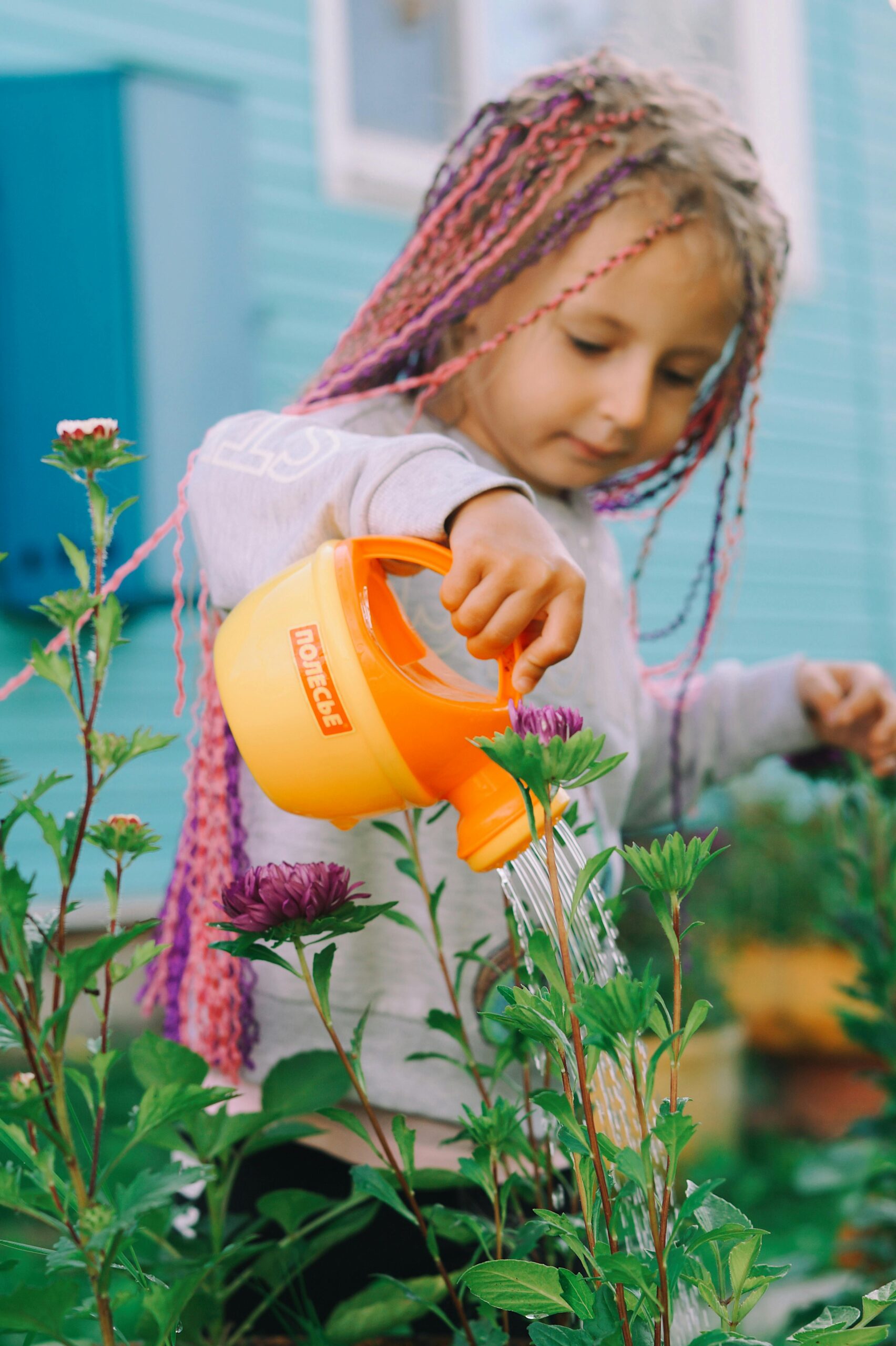
Think that “garden irrigation” means stumbling across your lawn with heavy watering containers? How to untangle endless hosepipes. Decide between sprinklers and irrigation systems?
How can you minimise the impact of a “drought plus hosepipe ban” on your garden and lawn?
It’s time to change your mind if you want to know how to water your gardens efficiently, and spend as little time, money and effort on them as possible.
I visited RHS Hilltop in Wisley recently, which is the UK’s only dedicated horticultural science centre.
Janet Manning is the Royal Horticultural Society’s Water Management Horticultural Consultant. She explains how to get the most out of your water and how to train your plants to require less water.
Water your garden effectively.
Janet says, “Start by examining your soil.” Your soil is your largest reservoir of water.
Mulch is the best way to start with your soil. The soil is full of microorganisms. They break down the mulch by feeding on it. This process helps the soil to retain water and allows plants to access nutrients.
Janet says that people think it’s impossible to mulch during a drought. However, if you use straw or chunky mulch, which allows water to reach the roots, you can mulch at any time.
She explains that fine mulches, like well-rotted compost from the garden or commercial mulches, hold water in the top layer. On a dry, hot day, the water evaporates off the top layer, preventing the moisture from reaching the roots.
If you choose mulch with small pieces of material, such as straw-based mulch or bark chips, that allow water to pass through, the water will drain. The protective layer of chunky material will also reduce evaporation during a hot summer day.
All this means less watering for the garden.
The chunky mulch used at RHS Wisley lets rainwater drip down to the soil, protecting it from evaporation.
She says that if you can collect water in the soil, you don’t need to carry it all around. Mulching has many other benefits, including suppressing weeds and insulating plant roots against heat or cold.
How often should I mulch my garden to reduce watering?
No exact answer is available.
Janet says that in hot weather, the soil will accelerate, and the microorganisms may speed up. This could allow the mulch to be absorbed faster. If your mulch has disappeared, you can add more.
In hot weather, use chunky mulch, not finer mulch.
Janet recommends that you spread finer mulches on your soil in the early spring or fall. In spring or fall, the soil should be damp. If you have an unusually dry spring, keep this in mind as you choose the mulch.
Mulch is used in different ways by different gardeners. Find out which mulch best suits your gardening style.
Learn how to make your plants need less water.
Janet explains that plants act as water pumps. Plants absorb moisture from the ground and release it into the air through their leaves.
They will increase their activity when there is more moisture in the soil. When there is less water in the soil, they will also detect it and slow down the process. They will close the tiny holes called stomata in their leaves. This reduces the need for them to absorb water from the soil. Janet says that they will only do this when the soil is very dry.
If you continue to water your plants, they will use more water. If you water less, for example by increasing the time between waterings, the plants will use less water.
Janet has helped me plant several new perennials along my border. In the summer, I watered my new plants three to four times weekly to establish them.
This year, however, I have checked the soil surrounding the plants to determine that they do not need as much water. I water my plants once or twice per week, depending on whether it has rained. They seem to be doing better than normal!
The right plant in the right place will save you from watering.
You may think it’s obvious, but you don’t have to fuss about your plants if they grow where they want to.
Janet says that if you want to prevent a plant from dying, you must water it more frequently.
Consider the sun and shade. Consider how moist or dry the soil is.
These posts will help you find the perfect plants for your specific situation.
Don’t move a plant in summer if you believe it is in the wrong spot and it seems to be dying due to heat or drought. It is best to water it regularly, and then move it when the weather cools down.
Here’s some more information on how to treat plants that are suffering in a heat wave or drought:
Are your plants dying in the garden? How to protect them from the summer heat.
How often should I water my garden during the summer?
Many questions regarding garden watering are difficult to answer because summers can be hotter and drier than others.
It is not logical to tell plants to use the same amount of water every time, because the weather can change and plants’ water requirements vary.
Perennials, shrubs, and annuals need more water than pots, and watering small pots is more important than watering large pots.
If you are unsure when to water, either feel the soil with your hands or use a moisture sensor.
It will need to be watered if it is dusty or dry an inch or two down. You don’t have to water your soil if it still feels damp and springy.
The same principle applies when you decide when to water your houseplants. Prick your finger into the soil. You can tell if the soil is too moist or dry to water.
Three important principles govern the watering of a garden. Mulch the soil, choose the right plants and test the soil before you water. You can tell if the soil is too moist (or dry).
Is it worth buying water barrels and water butts?
Does it make sense to invest in a rain barrel or water butt? Janet says yes. Buy as many rain barrels and water butts as possible. Buy them in the largest size you can.
Rainwater is not only free but also better for plants than tap water. Tap water is buffered to maintain a specific pH level to protect pipes and equipment, while rainwater absorbs the pH level of the soil as it runs through.
Rainwater that you use on your garden will not go into the drains, causing flash floods in your neighbourhood.
Fill them with rainwater from your shed or main roof. Install a rainwater diverter to prevent flooding. It will redirect rainwater into the drains until the water barrel has room again.
However, you should read the instructions on how to position the diverter. Janet says it’s a common error to place the diverter too high! It should be placed at the same level as the rain barrel or water tank. If it’s higher, you will get rainwater flooding your terrace.
A common mistake is leaving the tap open. If you are wondering why your water tank never fills up, it could be because the ‘open/shut’ sign on the tap doesn’t always make sense.
It’s also important that the lid stays in place and doesn’t fall off. Birds and other small mammals can drown if they fall into the container.
It is also possible to install a series of rain barrels/waterbutts by connecting them with hosepipes and siphoning the water between each one.
If you fill the waterbutts all at once with the hosepipe, they will work as one. This will require some research and checking of levels, but it will save you a lot of time stumbling around with watering cans.
Is rainwater harvesting legal?
The rainwater harvesting process involves using a rain barrel or tank to collect rainwater, usually from the roof. Some people believe that rainwater harvesting is illegal in certain countries, such as the UK.
It’s not true. Or rather, it’s misunderstood. Rainwater harvesting is encouraged to water your garden.
It is illegal to sell rainwater, and you cannot drink it.
Mains2Rains is a project of the RHS and Cranfield University that explains how to make use of rainwater.
Does it make sense to invest in an irrigation system for my garden?
Janet recommends that you consider whether you need one. If you have many pots or a greenhouse with many seed trays, you will need to water them regularly. Vegetables may also need more water because they grow so quickly.
If you keep your soil healthy and plant the right flowers in flower borders, you will only have to water the border when you establish new plants. You’ll need to water only the new plants, not the entire border.
She advises that ‘Irrigation system management is important, just like anything else’. You can’t just leave it to run, because plants need different amounts of moisture depending on the climate.
Another issue is maintenance. Many pipes that have joints will need to be repaired at some point.
Can I water my plants with greywater?
Janet says that we will need to use more grey water in the future to water our gardens.
Nadine and Michael Lote’s show garden at RHS Hampton Court focused on the use of greywater in the garden.
Grey water is water that’s been used in the home for other purposes. Grey water is water that has been used in the house for another purpose, like washing or cooking.
Reuse any water that contains relatively little soap, or that contains items that can be composted. Grey water should not be reused if it includes raw meat juices or cooked food. Don’t use very soapy water, as the sodium content in soap can be harmful to plant roots.
Janet collects water in a small bowl to wash or rinse vegetables. She can then use the water in the garden.
The roots of plants do not like the sodium found in soap. Grey water can be found with little or no soap. The water is wasted in the shower or from the condenser.
If you are washing or preparing fruits or vegetables, water and peelings can be used in your garden.
By 2050, the UK is expected to run out of water by about a third. This means that everyone is using one-third less water today. Many countries already have a much higher water awareness than we do.
We will need to learn how to conserve water and reuse it.



Leave a Reply