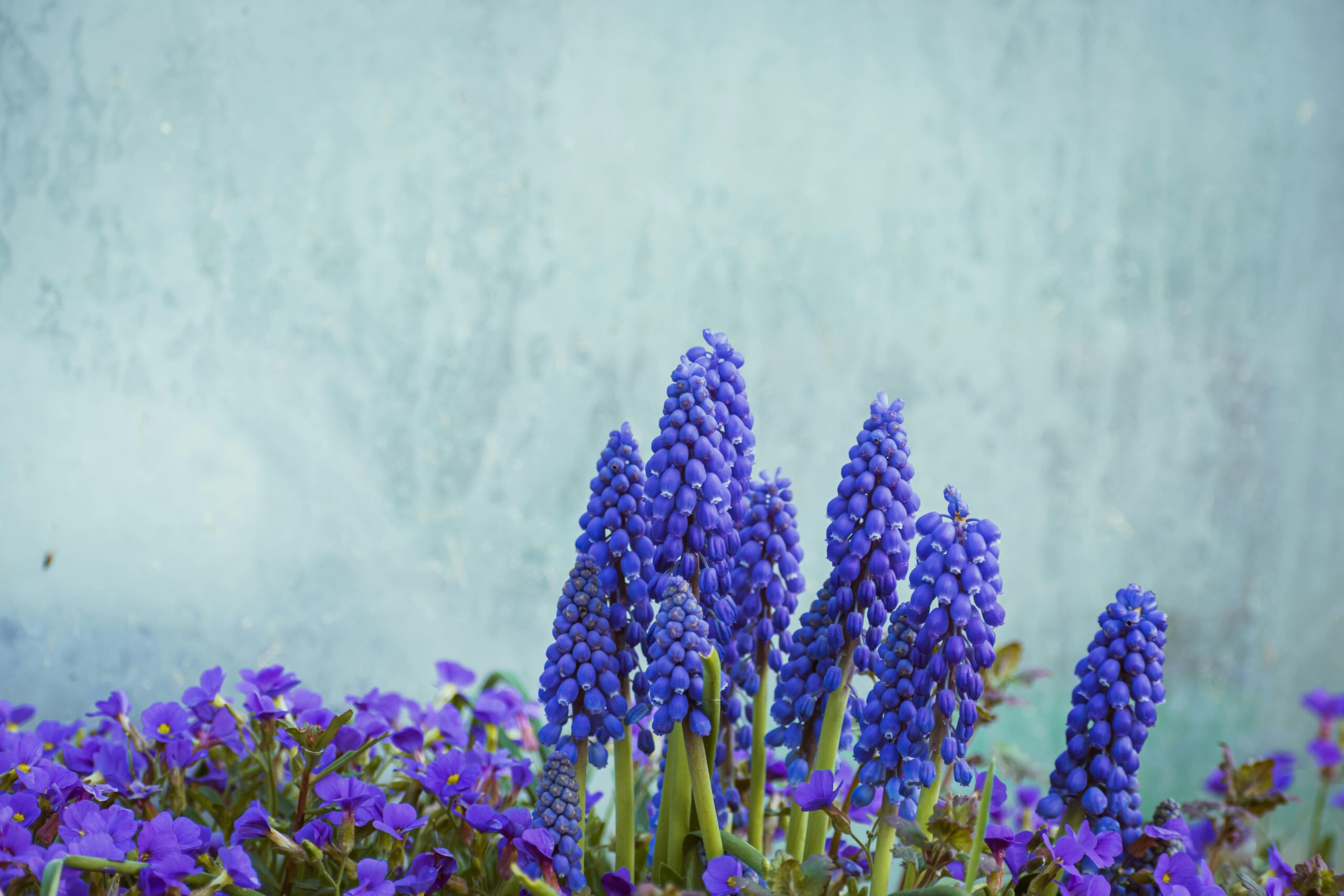
Grape Hyacinth is a perennial, early-blooming bulb of the Lily Family. It’s native to Southeast Europe. The common name, which is not a true Hyacinth but a hybrid, comes from the fact that the bell-shaped cobalt blue flowers look like upside-down grape clusters. Grape hyacinth can be grown in zones 3-9.
Common Bulbs
Many people dismiss these common flowers because they grow so quickly, are small, and are easy to overlook. They make a big impact in the landscape when planted in large numbers. They also attract early-flying pollinators. Grape Hyacinths planted under fruit trees can increase the chances of early foraging bees pollinating the trees. Honeybees gather on them immediately after they bloom, and this is a great source of nectar. Grape Hyacinths, although not native to the area, are a great resource when there aren’t many other flowers.
The long, linear leaves appear in spring and are followed by flowers. In early summer, the foliage is reabsorbed and dies. It reappears in fall. Grape Hyacinths are able to last for years and multiply on their own. You can enjoy them every spring simply by picking a few of the flowers and bringing them inside.
The flowers are tightly packed in clusters of grapes. If you look closely, the white edge around the flower stalks is visible.
Naturalize
Some people use crocus or daffodils to naturalise their lawns. Grape Hyacinths are another one I use. They are excellent for cutting and forcing. They also naturalise easily and spread, even seeding my lawn. Some consider them invasive, but they’re also beautiful in spring, and deer and bunnies leave them alone.
The Dutch ‘Blue River,’ a collection of grape hyacinths that are planted in rock gardens or on paths, is the most popular planting. This bulb is great for mixing with other bulbs. You can even use it to fill your meadow.
Grape hyacinths are inexpensive and can be used to add colour wherever you like. Grape hyacinths look great in loose drifts or masses, and they go well with spring bulbs such as crocus and Tulips. My favourite is the giant Snowdrop, Leucojum.
How to Grow
Grape hyacinth can be grown in the sun or partial shade, but the sun will produce the most flowers. Plant the bulbs as soon as you receive them, as they dry out very quickly. After flowering, let the foliage photosynthesise to provide energy for the bulb growth in the spring. The foliage, which has been dormant all summer, will appear again in fall.
Grape Hyacinths are available in purple, yellow, and blue hues. When placed in a vase, they add a grape bubblegum fragrance to the home. The bulbs are easy to grow in pots. I place the bulbs tightly in the pot, cover them with two inches of potting mix, and then place them into my cold frame with the lights blocked by shades. After hiding away all winter, I peeked out in early spring to see the Grape Hyacinths with their strap-like leaves.
In pots, it is easy to grow grape hyacinths.
Longfield Gardens supplied mine, along with some miniature daffodils. American Meadows has an excellent selection.
The white grape hyacinths don’t grow as well as the blue ones
About 40 different Muscari species exist, but few of them are available.
- M. M. azureum has flowers that are brighter blue and open wider than M. armeniacum. armeniacum. This species grows to a height of 4-6 inches and blooms early in the spring. This variety is M. The variety M.
- M. Armeniacum Fantasy Creation- a double which is said to look similar to broccoli
- Blue Spike – double florets with flax blue flowers on branched flower stems.
- Carneum – pinkish flowers
- Cantab is a slightly aromatic sky blue flower that blooms somewhat earlier than standard.
- M. Comosum or the tassel Hyacinth blooms late in spring with brownish-purplish flowers on 8-12 inch plants.
- M. This native pine forest plant in Turkey produces one leaf per bulb. Early spring blooms with bi-colored flower clusters. The top has pale blue florets, and the bottom is dark blue-black.
- ‘Superstar – densely packed periwinkle blue florets with white edges, topped by a cap of paler flowers.



Leave a Reply